The Salado Historical Society is dedicated to researching and preserving the history of the area and of the families that helped build this community. Their mission is “To locate, educate, and preserve the history and the historical integrity of the Village of Salado.”

I


The home that later became known as the Farr house originally stood one town north of its present location. In March 1875, William G. Ludlow purchased Lot 3, Block 87 in the original town of Belton, Texas and built two front rooms, large front and back porches, and a lean-to or detached kitchen at the rear of the house.
After purchasing the house in late 1877, J.A. Clark likely made the first addition, adding two rooms on the west side and extending the back porch along that wing. On June 2, 1879, Dr. Rezin S. Farr purchased the land and house at a cost of $2,500, and he and his wife, Mary Ellen, moved in a few months later.
In 1881, the cistern house, horse barn, and tack room-buggy shed were built. Although the exact dates are unclear, it is widely believed that the cistern and the rear porch wing were enclosed shortly after their construction. Around the turn of the twentieth century, the house was modernized with indoor plumbing, a bathroom, and electricity.
Dr. Farr’s daughters, Miss Bessie and Miss Kate, maintained the home until declining health forced them to move to Bryan, Texas, in 1968. Shortly after the sisters’ departure, vandals broke into the house and stole nearly all of its antiques, leaving only the pianoforte that was too heavy to move.
The Farr House nearly met its demise in June 1982, when the Belton fire marshal condemned the building. In an effort to save the house, it was featured on Belton’s seventh annual historical home tour in 1983, with plans to adapt the structure for use as professional offices. Unfortunately, those plans never came to fruition. In 1991, George Kolb stepped in to save the historic house. Because the area where the house stood had been converted into commercial land, Kolb arranged to move the house several miles south to Salado Victorian Oaks, where he promised to restore it. Kolb has since helped preserve historical homes in Salado.
Kolb preserved many of the Farr house’s original features, including the pine floors in the entry, front bedroom, living room, dining room, and kitchen; the cypress shutters; the original doors and rim locks; and the nineteenth-century iron wall braces in the dining room that reinforce the exterior walls. He also added a private rear wing with two large bedrooms and bathrooms. Today, this unique Greek Revival house with early Victorian country-style influences reflects the care and attention given to its preservation by successive owners. The restoration includes a recreation of the original porch railing, based on woodwork shown in early family photographs, as well as the restoration of the original iron fence. According to some of those involved in moving the house, the small cabin behind it may also have come from the Farr family’s original property in Belton.


One of the most fascinating chapters in Salado's history began in July 1873, when our small community in Bell County became the birthplace of the Grange movement in Texas and helped launch a movement that reached across Texas and into Indian Territory (now the State of Oklahoma).
Salado Grange No. 1 (Patrons of Husbandry) was created to help farmers who were struggling with high prices for supplies, poor prices for their crops, expensive transportation, and dependence on merchants and middlemen. Farmers could purchase supplies at the Grange and discuss crops and prices.
Families were often isolated from one another, so the Grange became an early social network. The Grange was used for meetings, and was a combination of a business, a meeting hall, and a center of community life. At a time when many civic and fraternal organizations were primarily male, the Grange admitted women as members on equal terms with men. The Grange fit into a community that already valued education and the exchange of ideas.
Eventually, droughts, economic difficulties, and competition contributed to the decline of the Grange stores by around 1890.

Early settlers who came to the Salado area found fertile land and abundant springs. It was here that residents built homes, churches, a school, and businesses, including gristmills, hotels, stores, and a distillery. It is to them we owe a debt of gratitude for their vision, hard work, spirit and fortitude in carving the village of Salado out of the limestone and flowing springs you see around us today.
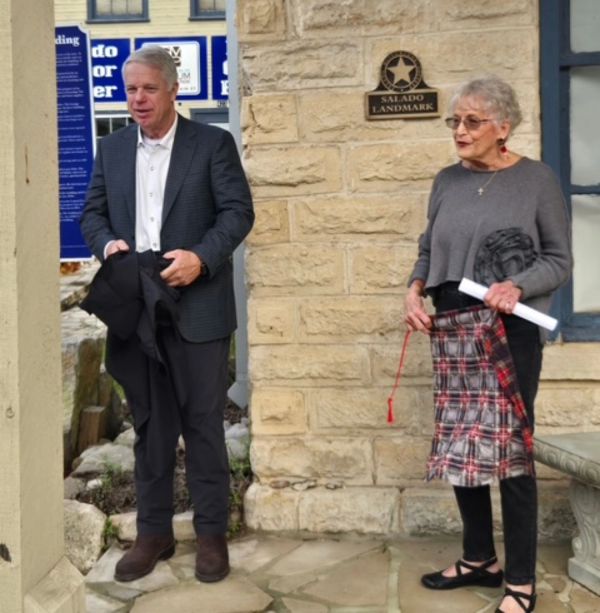
Many people visiting Salado say they love its history and that this history is what makes the village unique. These people are right: Salado’s historic significance has been acknowledged by the State of Texas and others as follows:
These include people, places, cemeteries, and mills. (Designated with RTHL)
Additionally, some of the RTHL are also NRHP.
Only 2 marked with an NRHP plaque are still standing. One site is marked as RTHL.
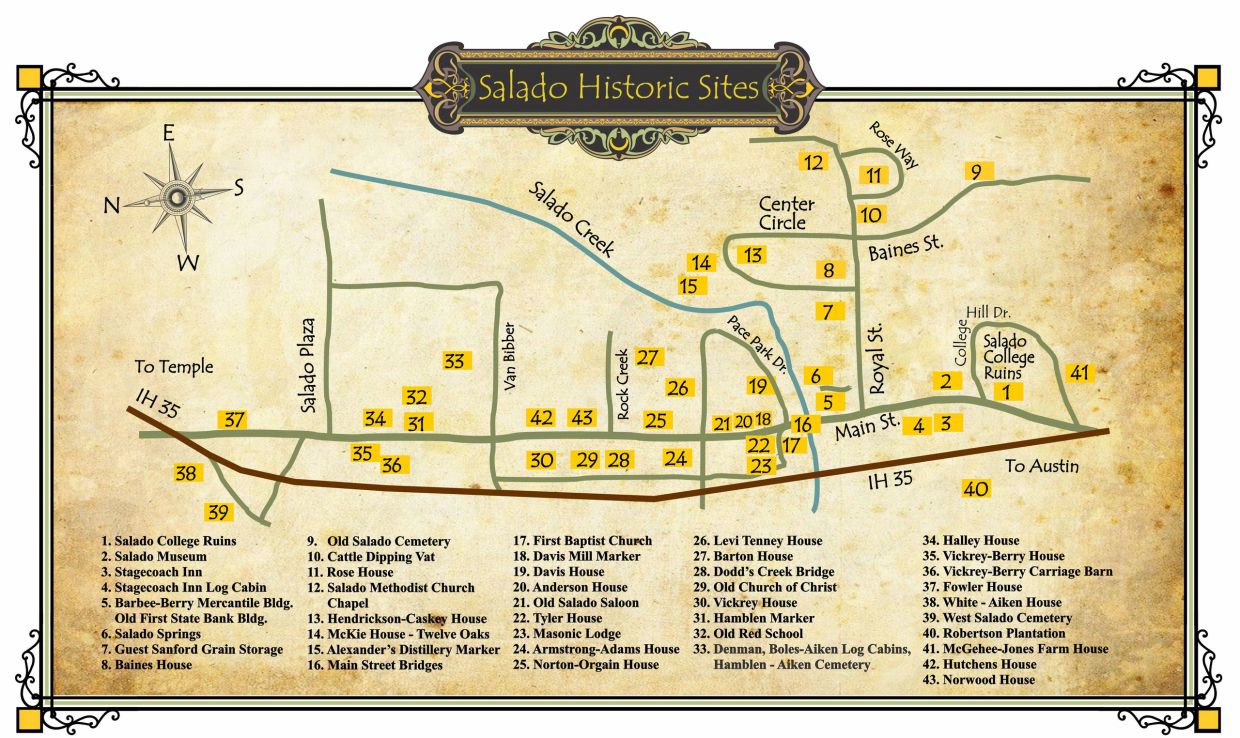
These many markers recognize pioneers and places of historic significance in Salado. They are described on this web site.

This area first called Salado Springs was part of the westward movement that brought pioneers from eastern states to Texas. The appeal of large tracts of fertile land was a major attraction. However, Salado offered something else few communities did: a college. In October of 1859 Col. E. S. C. Robertson donated 100 acres of land to build a college of which 90 acres were sold for town lots. The town was founded directly as a result of the establishment of the Salado College. Salado prospered as an educational and agricultural center for many decades. At one time a series of eight flour and grist mills were built on Salado Creek. Many of the historic homes and sites of early Salado are still an important part of this thriving, historic, village that you can see during your visit to Salado.


Your support and contributions will enable us to save the historic buildings of Salado. Your generous donation will allow our efforts to expand.
For information on lodging or more information about Salado go to www.VisitSaladoTexas.com